
Wishing all a very happy Earth Day!

Celebrating Colorado Heritage Plants in a Suburban Garden.
 |
| Simple, home-made drip-irrigation buckets simplify spot-watering. |
We’re
heading into a second year of drought in Western Colorado. Droughts can be a
challenge when getting new garden plants established. Sometimes we need to
supply a little extra water to an individual plant. And that’s where home-made
drip-irrigation buckets (we call them ‘Homer Buckets’) come in handy.
 |
| Five-gallon bucket with hole |
A
‘Homer Bucket’ is simply a 5-gallon plastic utility bucket with a single, small
diameter hole drilled near the bottom (see above). We use a drill with a 3/16 inch drill bit to
create the hole – located 1 inch from the bottom of the bucket. You'll need to test a bucket to see if this diameter allows water to seep optimally into your soil. You may need a smaller diameter hole (slow-draining soils), or larger for fast draining soils. The goal is to prevent water from running off, rather than soaking into the soil. We drill the hole in the same position on each
bucket, making it easy to position buckets for watering.
To
water, simply place the ‘Homer Bucket’ 8-10 inches from the plant, fill the
bucket with water, and let the water drain out through the hole (below). That’s it!
 |
| Watering buckets allow water to seep in, not run off. |
There
are several advantages to spot watering with ‘Homer Buckets’. First, they allow
you to direct the water to precisely where it’s needed. Second, the small hole
allows water to drain slowly, so water soaks into the ground, rather than
running off. Third, you are assured that
the plant gets a full 5-gallons of water – no more, no less. This can be especially helpful when children assist
with the watering. And it assures that precious
water isn’t wasted!
Fourth,
‘Homer Buckets’ allow you to water areas that are difficult to irrigate using
other methods. We’ve even used them for native plant restoration projects. Fifth, ‘Homer Buckets’ are easy and inexpensive
to make. They may even cost nothing, if
you have access to used 5-gallon paint buckets.
Lastly,
watering with ‘Homer Buckets’ is easy. Place
the buckets, fill them with a hose, then let the buckets drain for a half-hour
or so. You can efficiently and easily
water a number of plants by simply moving the buckets once they’ve drained. So undemanding!
We
hope you’ll consider making some ‘Homer Buckets’ for your own garden. They really are a fantastic solution for getting
water to plants – even in times of drought!
 |
| Consider home-made spot-watering buckets for your garden! |
_____________________________________________
We welcome your comments (below). You can also send your questions to: monaturesmontrosegarden@gmail.com
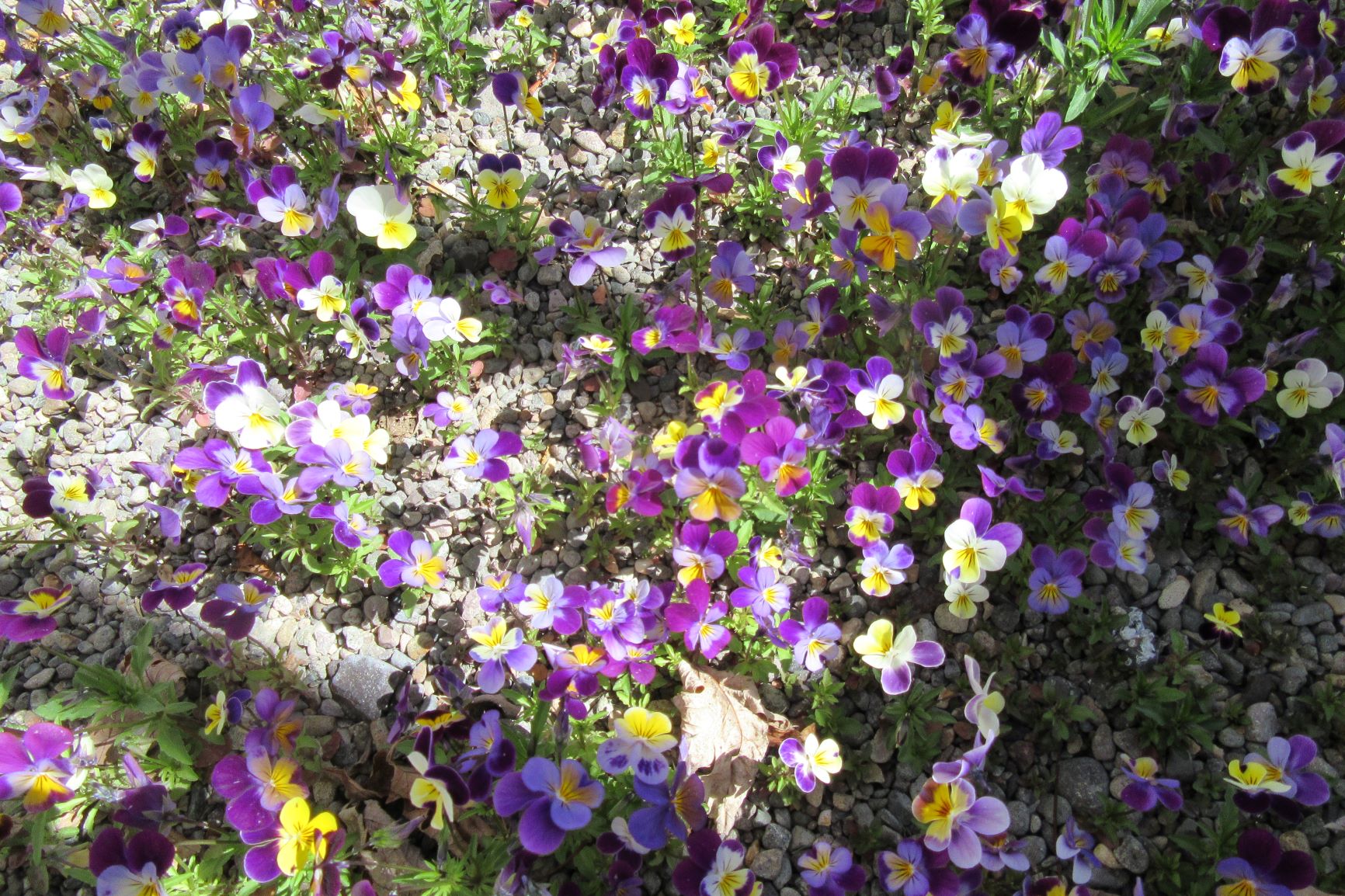 |
| Wild violet (Viola tricolor): An early spring treat in Mother Nature's Montrose Garden |
The weather can still be cold and blustery in early April. In Mother Nature’s Montrose Garden (USDA Zone 6), not much is flowering yet, although the trees, shrubs and perennials are starting to leaf out. One reliable early bloomer is the non-native Viola tricolor. It was planted by the former owner, and has re-seeded throughout the garden. The scientific name is pronounced vye-OH-lah TRY-color.
Wild
pansy is a common wildflower throughout much of Europe. Some of its common names include: heartsease,
heart's ease, heart's delight, tickle-my-fancy, Jack-jump-up-and-kiss-me, Johnny
Jump-Up, come-and-cuddle-me, three faces in a hood, love-in-idleness, or pink
of my john. [1] Planted in the U.S. since 1700’s, it can be found in many U.S.
gardens. It’s readily available and commonly
sold as both plants and seeds. The
showier horticultural pansies were developed from the wild Viola tricolor. All are members of the
Violaceae (Violet family).
 |
| Wild violet (Viola tricolor): small annual plant |
Wild
pansy is an annual or short-lived perennial, but freely reseeds. Plants are
small, usually under 6-8 inches (15-18 cm) in height (but up to 12 inches in
milder climates) and perhaps slightly more in diameter. The leaves are
alternate and mostly oblong or lance-shaped, of a medium green that may be red-
or purple-tinged early in the season. The leaves have a variety of
shapes. The lower blades are heart to egg shaped.
In
the wilds, Viola tricolor grows in European meadows,
banks, fields and open areas. It can be
grown – as an annual – in all USDA Climate Zones. Johnny
Jump-ups like cool weather and will die back with the heat. In hot gardens they will appreciate a bit of
shade, at least in the afternoons.
 |
| Wild violet (Viola tricolor): flowers |
The
flowers of Viola tricolor are truly charming;
small but nicely colored. It blooms spring-summer (March-Sept). The
flowers are solitary on stems above the foliage. A typical flower
has violet or purple upper petals, white lateral petals and a yellow lower
petal (see above). Several purple veins originate from the flowers'
throat. Some flowers are only purple, or two-toned – even all yellow or
white.
The
plants are self-fertile and pollinated by bees. After blooming, the
fertile flowers are replaced by seed capsules. When mature, the capsule
will divide into 3 parts and the seeds ejected. [2]
 |
| Wild violet (Viola tricolor): late winter seedlings |
The
seeds are small and can easily be carried on the wind. Seedlings tend to ‘jump
up’ in favorable locations in the garden – hence the common name Johnny Jump-up.
Thus, a few plants or packet of seeds can provide many years of enjoyment.
Seedlings may emerge with cool fall weather, or with the warming soils of
spring (see photos above and below).
 |
| Wild violet (Viola tricolor): seeds spread by wind create a colony of plants |
Many
gardeners prefer to purchase nursery-grown plants. In that case, space plants one
foot apart and be sure to water them in well. But starting plants from seed is quite easy. If
planting from seed, sow seeds in prepared beds in late winter or early spring. They can also be started in pots indoors to
plant out later. Just barely cover the
seeds, keep the soil moist and look for germination in 2-3 weeks. Slugs and snails like the tender foliage, so
watch for them!
Wild
violet prefers cool, moist well-drained humus-rich soil. It does well in
partial or dappled shade with protection from hot winds. It tolerates many soils
but prefers a pH between 6 and 6.5 [3]
That being said, plants do very well in Mother Nature’s Montrose Garden,
with a pH of near 8.0.
There
are many uses for Viola tricolor in the home garden. Many gardeners use it to border paths or flower
beds. It looks stunning massed as a
groundcover. It is right at home in an alpine or rock garden; it would also be
nice in an herb garden or around the edges of a vegetable plot. It can be grown in containers, making it
accessible to most. And it does a lovely
job of naturalizing around shrubs and perennials. Yellow, green and blue-green dyes are
obtained from the flowers. The leaves can be used in place of litmus in testing
for acids and alkalis.
 |
| Wild violet (Viola tricolor): makes a good filler plant |
Wild
pansy is edible in small amounts; it contains chemicals that can be mildly
toxic in large amounts. Young leaves and flower buds can be eaten (raw or
cooked) or used to thicken soups. The flowers can be used as an attractive garnish
for salads. The leaves are sometimes
also dried for tea. [3]
The
plant has a long history of medicinal use in Europe. The most common uses, to this day, are for
skin conditions such as eczema and hives. But the species was once used to treat epilepsy,
asthma, skin diseases and a wide range of other complaints. The plant was also traditionally known as a
source for love potions, and is even referenced as such in Shakespeare’s plays.
[3]
Teas
made from the dried plant promote coughing up phlegm, and were used for
respiratory problems such as bronchitis, asthma, and cold symptoms. Ointments, salves and poultices have been
used in the treatment of diaper rash, weeping sores, itchy skin, varicose
ulcers and ringworm. [2] Viola tricolor and other species in the
Violet family produce a number of interesting plant chemicals. They are currently being studied to determine
their usefulness in modern medicine.
In
summary, Wild violet is a wonderful addition to the early spring garden. It
adds an old-fashioned beauty to any setting.
While not a U.S. native, it works well with native plants, naturalizing
around the garden like the native wildflowers. Why not consider this little charmer for your
own garden, even if just as a container plant?
 |
| Wild violet (Viola tricolor): in gravel mulch |
__________________
 |
| Rabbitbrush shrubs need spring pruning. |
Spring
is almost here. The weather in Mother Nature’s Montrose Garden fluctuates
between the chilly 40’s and pleasantly warm, although most nights hover around
freezing. Some of the hardier shrubs are just beginning to leaf out. One group of native bush Sunflowers – the Rabbitbrushes
– are among the first. And that means it’s
time to prune them!
Several
species of Rabbitbrush are native to the Four Corners states. We’ll feature a
few as Plants of the Month in the coming year.
But in terms of pruning, the rules are pretty much the same. Rabbitbrushes are pruned in early spring,
when they begin to bud out – much like their cousins the Artemisias. And
they are pruned quite substantially; also like some of the Artemisias.
 |
| Budbreak in Rabbitbush |
In
the wilds, bush Sunflowers like the Rabbitbrushes provide important winter
browse for large animals like deer and elk, as well as smaller mammals (rabbits,
ground squirrels, pocket gophers, etc.). By late winter, plants are often severely eaten
down by the wildlife. And, since The Rabbitbrushes and their native ‘pruners’
evolved together, Rabbitbrushes have developed the ability to grow back
vigorously each spring.
 |
| Begin pruning Rabbitbrush the year after planting. |
In
fact, many native bush Sunflowers need a good pruning each spring. If
they don’t get it, plants become woody, leggy – in short, less attractive than
they should be. And pruning needs to begin in the first year after planting to
keep a Rabbitbrush shrub full and lush (as they are in the wilds).
 |
| Rabbitbrush in early spring. Note green stems and sprouting buds. |
Unlike some
shrubs, Rabbitbrushes retain the ability to sprout from older wood. As shown
above, even branches with a diameter of an inch or so are green; and buds can
be seen below the cut. This means you can prune a Rabbitbrush branch
quite hard, as long as you leave at least four buds below the cut.
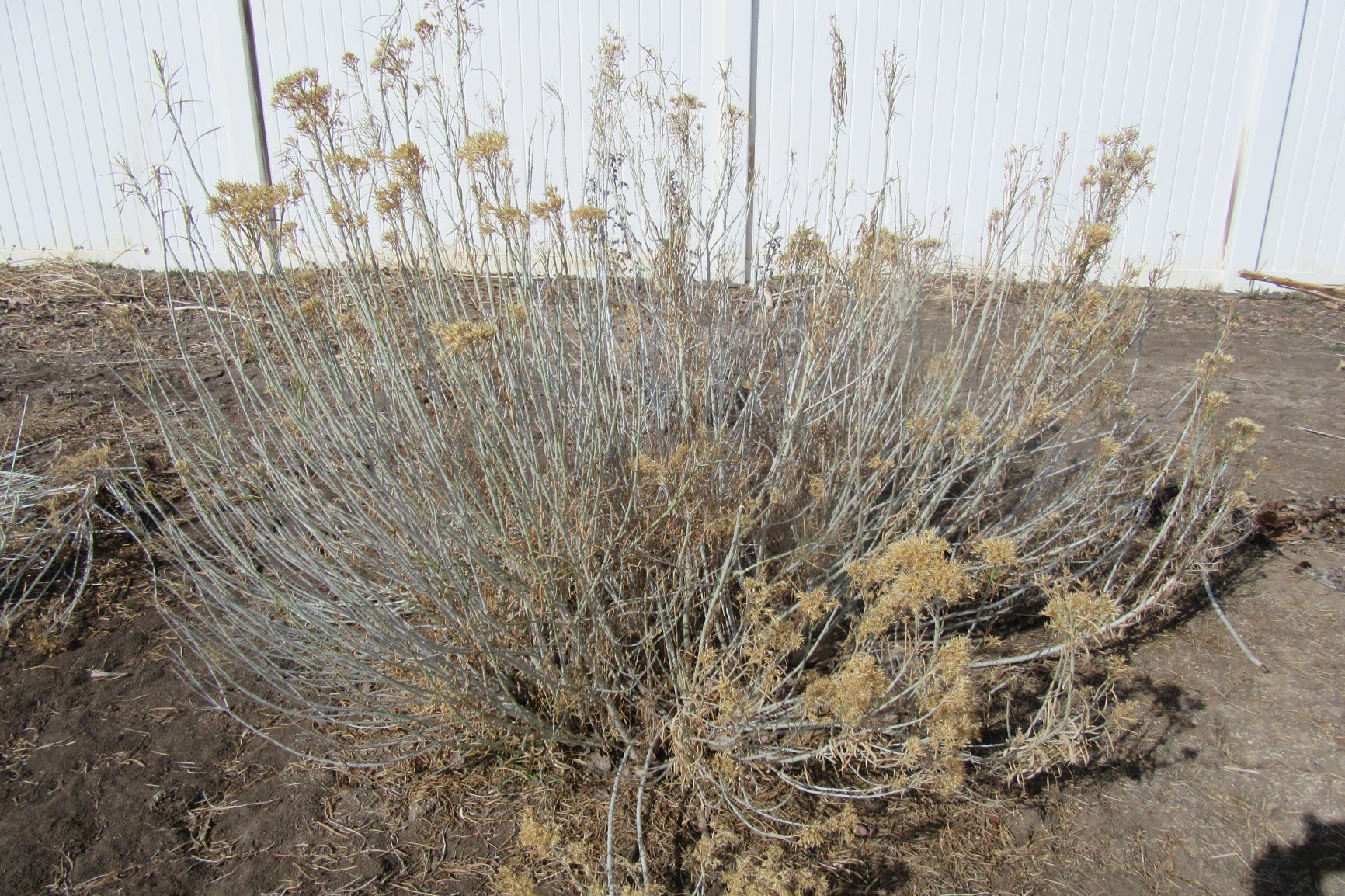 |
| Rabbitbrush before spring pruning. |
Above
is a Rabbitbrush before pruning. The
shrub was left unpruned over the winter (you can still see remnants of flowers
and old leaves). In colder climates (we’re
USDA Zone 6), old growth is left on the plants to protect them from winter
chill.
 |
| Partially pruned Rabbitbrush. |
To
give you an idea of our recommended pruning strategy, the picture above shows a
plant that is half pruned. You can see
that quite a bit of mass – up to two-thirds of the branch length – can be
removed, as long as there are heathy buds beneath. The photo below shows a fully pruned bush.
 |
| Fully pruning Rabbitbrush. |
At
this point we leave the prunings around the plant to protect it and conserve
soil moisture. When the trimmings are
dry, we’ll cut them into smaller pieces and use them as mulch. And that’s pretty much all there is to say
about pruning Rabbitbrushes.

We welcome your comments (below). You can also send your questions to: monaturesmontrosegarden@gmail.com
 |
| Meadow Onion (Allium unifolium): late spring |
There’s
not much going on in our Zone 6 garden in early March. But some of the bulbs we
planted last fall are starting to break ground, including Allium unifolium.
So we decided to feature this lovely true bulb as our Plant of the Month. The scientific name is pronounced: AL-ee-um
yu-nee-FOE-lee-um.
The
Meadow onion is not native to Colorado.
It grows along the Central and Northern coast of California, from San
Luis Obispo County into Oregon, and also in Baja California. It grows in moist, often grassy areas on
coastal cliffs in the coastal pine and mixed evergreen forests. It tolerates moist soils and is most
comfortable in clay. These two
preferences make it a good choice for many gardens.
 |
| Meadow Onion (Allium unifolium): bulbs |
Allium unifolium is a true onion (genus Allium), a cousin to our culinary onions
and garlic. The onions were formerly
included in a large bulb-forming family, the Lilliaceae. Some taxonomists
now recommend placing the onions in their own family, the Alliaceae. Others place the onions in the Amaryllis Family (Amaryllidaceae), along with such garden
genera as Agapanthus, Amaryllis, Clivia, Narcissis and Zephyranthes. Only
time will tell where the Alliums will end up.
Colorado
has about ten different species of native Alliums. The vast majority grow on the Western Slope,
usually above about 5000 ft elevation. Six
are native to Montrose County but most are difficult to find, even as seeds.
Fortunately for Western gardeners, some non-local species can succeed in local
gardens – if only you can find a source for the bulbs! Fortunately, Allium unifolium is
available even from some traditional bulb growers like Van Engelen Inc. (it’s a
favorite in European gardens!).
 |
| Meadow Onion (Allium unifolium): early spring |
Like
most Alliums, Meadow onion is a fairly
simple perennial. Its leaves emerge from
the bulb with the late winter rains. We
often see them start to emerge in February in our garden. The leaves are the simple, strap-like leaves
of the onions. The genus name unifolium mean ‘single-leaf’; in fact,
another name for this plant is the One-leaf onion. As seen above, plants are indeed sparsely
leaved (one to four leaves is typical).
 |
| Meadow Onion (Allium unifolium): flower bud |
The
leaves often start to wither from the tips (and sometimes wither altogether)
before the flowers emerge. Meadow onion
blooms in spring or early summer: usually April or May, but a bit later in
colder climates. The flowers grow in dense
clusters (umbels) on 1-2 foot (30-45 cm) flowering stalks. If you live in a dry
place like much of Western Colorado, the flowering stalks may be a little
shorter. The buds are tightly packed in
a membranous sheath (see above) at the tip of the growing flower stalk. The stalks grow very quickly to their full
height.
 |
| Meadow Onion (Allium unifolium): floral cluster |
Meadow
onion has the star- or bell-shaped flowers typical of the onions. The six veined ‘petals’ are actually tepals
(petals and sepals look alike). The
flowers are individually small (about ½ an inch across), but with 15 or more
flowers per umbel, this onion is a showy bloomer. The flower color is most often a pale
lavender or pale pink, though white-flowering forms are known.
 |
| Meadow Onion (Allium unifolium): flowers |
The
flowers contain both male and female parts (‘perfect’ flowers). The pollen in this species is either gray or
yellow. The plants produce seeds in our
garden, so they do attract some insect pollinators with their mildly sweet
aroma. While the literature specifies
bees as pollinators, we more often see the flower flies (below).
 |
| Meadow Onion (Allium unifolium): flowerfly (pollinator) |
Allium
unifolium is easy to grow.
It can be grown in just about any soil, although it prefers the
moisture-retaining clays. It needs a
neutral to alkali soil (pH 7.0-9.0). While it grows in full sun in Oregon,
gardeners in warmer climates should plant this species in part shade (afternoon
shade to fairly shady). This plant does
need good winter/early spring rains. We sometimes
have to supplement ours in dry winters.
Unlike some native bulbs, this species can take occasional summer water.
We
let our plants go to seed, then let them self-seed naturally (or spread them
where we want to start a new patch).
Patches increase slowly both by seed and by offsets (new little
bulbs). A modest investment in bulbs
will increase to a nice grouping within 4-5 years. We like to start out by planting 8-10 bulbs
within a 2 square foot area. Don’t
worry about critters digging up the bulbs – they tend to leave onions alone.
For more on planting bulbs see:
 |
| Meadow Onion (Allium unifolium): in garden |
We
love the flowers of this onion. The
color contrasts nicely with native grasses and wildflowers. It’s great for brightening shady areas of the
garden, for example, under trees. The
plants naturalize nicely, and can help ‘tie together’ parts of the garden with
their pastel leaves and flowers.
Bulbs
are a perfect choice for bordering pathways, as an accent plant in a rock
garden or along a garden wall. Meadow onion’s flowers have a light, sweet
fragrance, making them a good choice for containers near seating areas and as cut
flowers. This bulb would do well around
the drier edges of a vegetable garden or in an herb garden. Native Californians did not eat it; however, at
least one blogger uses the stems as a flavoring agent [ref. 1, below].
 |
| Meadow Onion (Allium unifolium): with other wildflowers |
So
why include Meadow onion in your garden?
First, it’s easy to grow and available from bulb dealers. Second, it’s a little charmer that’s adaptable
to garden challenges like clay soil and a bit of shade. Thirdly, it provides an economical solution
to providing masses of spring color – or to naturalize.
If
you desire, Allium unifolium can be used as a flavoring agent. The flavor is similar to that of garden
onions – perhaps even better. All parts are edible, including the flowers (in a
salad or as a garnish), leaves, flowering stems and bulb. Consider growing this
in the vegetable garden, along with your chives or garlic-chives.
And
finally, Meadow onion has all the magic of a native perennial bulb. It gives you something to look forward to,
without much care, year after year. It’s
a seasonal treat, anticipated and enjoyed, that ties us to the land and its
seasons. We echo many previous garden
mavens, in singing the praises of garden bulbs.

For more on
gardening with native bulbs see: https://mothernaturesmontrosegarden.blogspot.com/2020/10/gardening-tip-planting-native-flower.html
For a
gardening information sheet see: Co
gardening sheet allium unifolium (slideshare.net)
For more
pictures of this plant see: http://www.slideshare.net/cvadheim/allium-unifolium-web-show
For plant
information sheets on other Western native plants see: http://nativeplantscsudh.blogspot.com/p/gallery-of-native-plants_17.html
________________
__________________________________________________________
We welcome your comments
(below). You can also send your
questions to: monaturesmontrosegarden@gmail.com
 |
| Purple Coneflower (Echinacea purpurea): plants in winter |
February can be unpredictable in the Four Corners region. Weather can go from warm and sunny to cold and snowy very quickly. Making the garden look good this time of year can be a challenge. Plants that provide structural interest, even in winter, are a welcome solution. One such plant is the Purple Coneflower or Echinacea purpurea. The scientific name is pronounced eck-kin-NAY-see-uh pur-PURR-ee-uh.
Purple coneflower was probably never native to
Colorado, although it does grow in neighboring Kansas. This is really a wildflower of the eastern,
southeastern and midwestern United States. It grows wild in prairies and open
woodlands from Florida to the Canadian Province of Ontario. It is commonly known as Purple Coneflower, Eastern
Purple Coneflower, Hedgehog Coneflower and Echinacea.
 |
| Purple Coneflower (Echinacea purpurea): in Sunflower family. |
Purple coneflower is a member of the Sunflower
family (Asteraceae). It was originally
named Rudbeckia purpurea by Linnaeus in 1753. [1] It was reclassified as Echinacea purpurea
in 1794, so this
species has been known to the scientific world for some time. And it
has long been used in gardens, although its popularity has greatly increased since
the 1990’s, when it became more readily available.
Why
plant a non-native sunflower in Western Colorado, particularly in a garden with
a preponderance of Colorado and Western plants?
For several reasons, including its aesthetic characteristics, hardiness,
un-fussy growth requirements and ease of propagation. All of this make Echinacea purpurea a
popular garden plant on the Western Slope.
 |
| Purple Coneflower (Echinacea purpurea): growth habit |
Purple coneflower is an herbaceous perennial that
common grows 2-4 ft. tall by 1-2 ft. wide (up to a meter tall by 25-30 cm). The
foliage is somewhat coarse/bold in appearance (it is, after all, a sunflower).
The stems are stiff and upright. The largest
leaves are low on the stems (5-12 inches long; 2-5 inches wide), simple and alternate,
often with toothed margins (below). The
foliage is dark green, sometimes even tinged with purple. The darker foliage contrasts nicely with many
local shrubs that have silvery or blue-green foliage.
 |
| Purple Coneflower (Echinacea purpurea): foliage |
Echinacea purpurea
is a long blooming species, with the exact bloom period depending on the local
climate. In milder areas, it may bloom
as early as April. In our part of
Western Colorado, it’s mainly a summer through fall bloomer, with heaviest
blooming in early summer and late summer/early fall. The long bloom period is another reason for this
species popularity.
 |
| Purple Coneflower (Echinacea purpurea): flower (close-up) |
The flowers of Purple coneflower exhibit the basic characteristics of the Asteraceae. Flowers are clustered in ‘sunflower heads’, with lighter-colored ray flowers and darker disc flowers to the center (above). The ray flowers are most typically purple or lilac, but may be white or pink. The disc flowers cluster on a dome-shaped disc, which may be nearly flat to almost spherical. The disc flowers, which are yellow or orange, produce the seeds (ray flowers are sterile).
 |
| Purple Coneflower (Echinacea purpurea): pale flowered variant. |
We’ve noticed quite a bit of floral variability in the offspring of several plants we purchased last year. Most have purple ray flowers (like the parents), but some have white rays and others lighter lilac-colored rays. Some have rays that are strongly recurved; others almost straight. Some have barely any ray flowers at all. And all this from three purchased plants with ‘typical’ purple flowers!
 |
| Purple Coneflower (Echinacea purpurea): white-flowered variant |
The
natural variability of the species facilitates the development of cultivars
with special characteristics. Cultivars such as 'White Swan' and ‘PowWow White’
have white flowers; 'Magnus' has bigger, flatter, purple rays, and ‘Ruby Star’
('Rubenstern’) has darker, more recurved rays.
We suspect some hanky-panky produced the plants we purchased as the
straight species! And while we’re on the
subject of cultivars, 'Kim's Knee High' and ‘Prairie Splendor’ are shorter
plants (less than 2 ft.) with classic rose-purple flowers. So, there’s something for every taste and requirement
(unless you simply don’t like sunflowers).
 |
| Purple Coneflower (Echinacea purpurea): easy to grow |
Purple
coneflower is easily grown in gardens from USDA Zones 3 to 8. It’s not particular about soil texture or pH
(except very acidic soils). While usually grown in full sun, it tolerates
part-shade. It’s a good bet for hot, dry
sites, thriving on average or somewhat dry soils (our Water Zones 2 and 3 – see
https://www.slideshare.net/cvadheim/water-zone-gardening). But it’s not picky about water needs; it can
take regular water.
 |
| Purple Coneflower (Echinacea purpurea): seedlings around mother plant |
Echinacea purpurea
is not a particularly long-lived
perennial, at least not in Mother Nature’s Montrose Garden. However, it does re-seed nicely – perhaps even
too much so. If you need to contain it,
deadhead to prevent the seeds from maturing. On the other hand, the seeds serve
as a good source of winter food for seed-eating birds. And the bare seed heads add interest to the
winter garden.
We
don’t cut our Coneflowers back until spring.
Not only do perennials like Echinacea provide winter color. But
retaining the old foliage helps the plants survive cold winter weather. So, we
wait until the spring warm-up to cut back the dead perennial foliage.
 |
| Purple Coneflower (Echinacea purpurea): seeds provide winter food for birds |
The
reasons to include Purple coneflower in a garden are
many. If you’re into habitat gardening,
this species provides needed seasonal food. In addition to the seeds, the
flowers provide nectar and pollen for a range of pollinators including native
bees, hummingbirds and butterflies. The foliage also provides larval
(caterpillar) food for the Silvery Checkerspot Butterfly and several species of
moths.
 |
| Purple Coneflower (Echinacea purpurea): medicinal plant |
The
medicinal gardener will recognize Echinacea purpurea as a medicinal plant.
In fact, extracts of Echinacea root are widely sold, with claims that they
boost immunity. Some studies do suggest
that secondary metabolites produced by Echinacea species stimulate production
of certain immune cells. [2] The species
has a history of use treating many ailments, particularly those with an
infectious component. At any rate, the
flowers can be used to make a soothing tea, which may have beneficial
effects. As always, herbal medicines
should be used in moderation, and only after consulting your healthcare
provider.
 |
| Purple Coneflower (Echinacea purpurea): makes a good filler plant while shrubs are growiing |
The
most common reasons for planting Purple coneflower are its pretty flowers, long
bloom season and modest care requirements.
The species is a good choice for filling in bare spots in the garden, particularly
in a garden with new shrubs. It naturalizes nicely if allowed to do so. And the flowers make attractive, long-lasting
cut flowers.
 |
| Purple Coneflower (Echinacea purpurea): showy flowers make this a popular perennial. |
Purple
coneflower is showy when massed. It is a widely recognized and acceptable wildflower;
a useful complement to shrubs and lawn, even in front yards. Its hardy constitution makes it suitable for harsh
conditions along curbs and walkways. It can be used in a naturalistic or
cottage garden, prairie/meadow garden or traditional flower bed.
 |
| Purple Coneflower (Echinacea purpurea): dark foilage contrasts nicely with silvery native shrubs. |
The
relatively dark green foliage looks good with many silvery-foliage native shrubs
and sub-shrubs. The purple flowers make
a lovely contrast, particularly with yellow-flowered sunflowers and white
flowered species. Try pairing it with such natural associates as Coreopsis major,
Rudbeckia hirta, Monarda fistulosa, Liatris spicata, Schizachyrium
scoparium and Andropogon species for a prairie garden.
In
summary, while not a Colorado native plant, Purple coneflower has many useful
attributes. It’s readily available – both as plants and seeds. There are
cultivars with specific properties. And
it looks nice with relatively little maintenance. That’s probably why it is seen so commonly in
local gardens. Could you use a plant or
two in your garden?
 |
| Purple Coneflower (Echinacea purpurea): a good choice for Western Colorado gardens. |
For a gardening
information sheet see: Gardening
sheet echinacea purpurea (slideshare.net)
For more
pictures of this plant see:
For plant
information sheets on other native plants see: http://nativeplantscsudh.blogspot.com/p/gallery-of-native-plants_17.html
_______
We
welcome your comments (below). You can
also send your questions to: monaturesmontrosegarden@gmail.com
 |
| Seeds that require winter chill can be planted out in winter or early spring. |
Growing
plants from seed has several advantages. It can be an enjoyable hobby, allowing
you to appreciate all stages of a plant’s life. It is often less expensive than
buying plants. And for some native species,
growing from seed can be the only option.
Seeds
of many woody and perennial plants from colder climates need winter chill
exposure in order to germinate. The need for chill is usually noted on the seed
packet, along with other planting instructions.
Some seeds also benefit from environmental alternations of warmer and
colder temperatures. Giving such seeds a
natural exposure in winter or early spring can be a good option.
We
like to start our woody trees and shrub seeds in 1-gallon containers. Those that need winter chill are planted and
set out in a sheltered area of the garden in January (above). In our
unpredictable climate, we check the pots every few days to be sure they aren’t
drying out, watering as required. That’s
really all we do until spring warm up, when pots are moved to our shade
structure.
 |
| Pots are moved to the shade structure in spring. |
____________________________
We welcome your comments (below). You can also send your questions to: monaturesmontrosegarden@gmail.com
