Showing posts with label Colorado-friendly garden. Show all posts

Friday, November 18, 2022

Plant of the Month (November) : Stiff Goldenrod – Solidago rigida/ Oligoneuron rigidum


Stiff Goldenrod (Solidago rigida / Oligoneuron rigidum): in winter


Attracting butterflies, other pollinators and birds is an important goal for many gardeners. The challenge is to provide plenty of food throughout the warm months – as well as some for winter.  The fall-blooming sunflowers are a great way to extend the gardening season – even into late fall. And one of our favorites is the Stiff Goldenrod. The scientific name is currently under some debate: this plant is known as either Solidago rigida or Oligoneuron rigidum. The genus Oligoneuron includes other flat-topped Goldenrods.  The name pronunciations are: so-lih-DAH-go  RIH-jid-uh and ah-lih-go-NYEW-ron  RIH-jid-um.

Stiff Goldenrod is native to much of the United States and southern Canada, with the exception of the Pacific Coast. In Colorado, Solidago rigida ssp. humilis grows wild on the Front Range and Eastern Plains. [1] The more common – and taller - Solidago rigida ssp. rigida occurs mostly on the midwestern plains and Eastern U.S.

Solidago rigida is a goldenrod of prairies, meadows and grassy woodland openings. The soils may be dry or not and range in texture from sandy to loamy. This hints that Stiff Goldenrod is adaptable to a range of garden conditions.  And, contrary to popular belief, Goldenrods do not cause hay fever (that honor goes to Ragweed, which often blooms at the same time).


Stiff Goldenrod (Solidago rigida / Oligoneuron rigidum):
growth habit


Stiff Goldenrod is a winter-deciduous perennial. The plant dies back to a basal rosette, which may remain partly green throughout the cold season (above).  The growth habit consists of this basal rosette, whose leaves may be up to 8 inches long and 2 inches wide, and erect flowering stems. 


Stiff Goldenrod (Solidago rigida / Oligoneuron rigidum): foliage


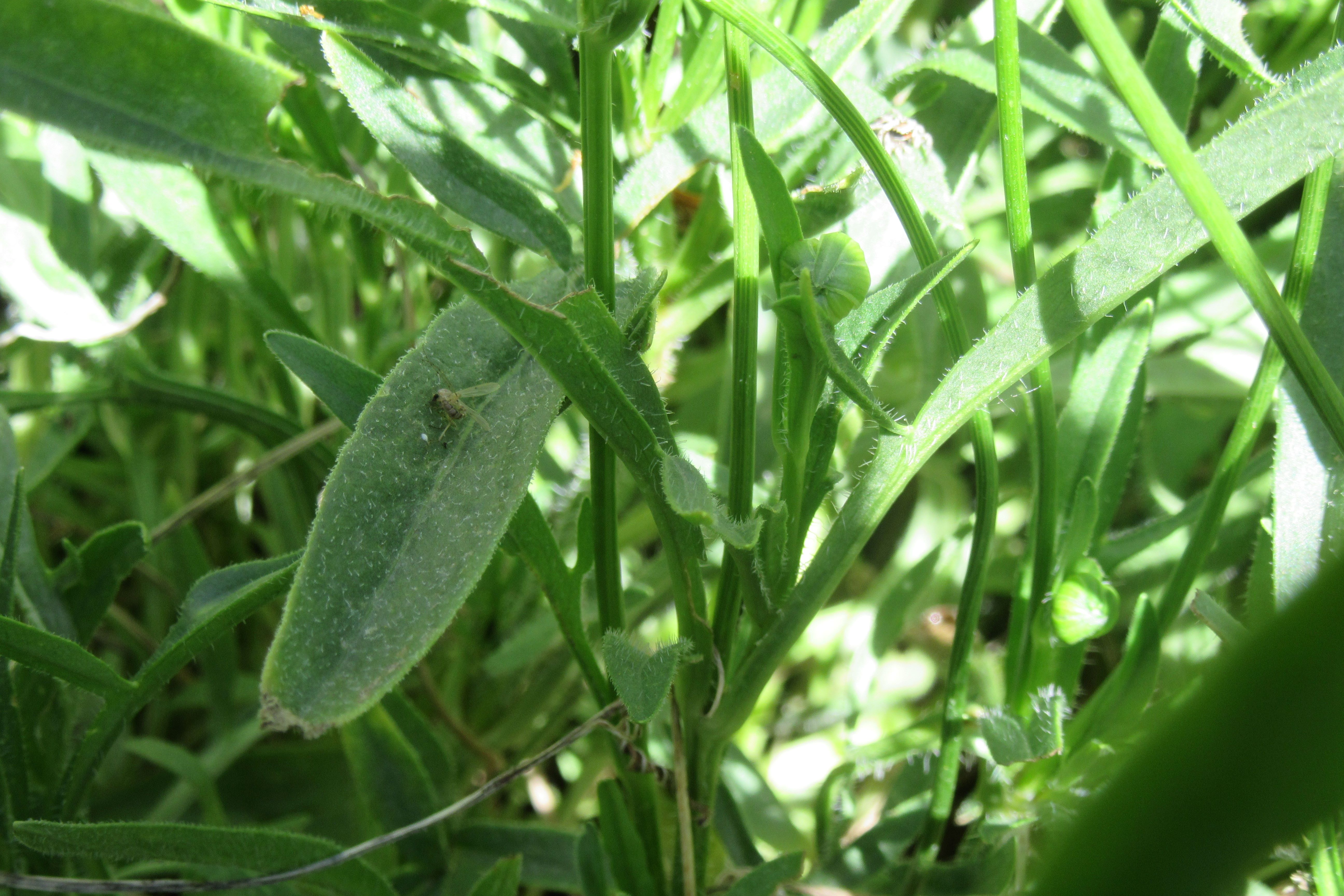
The stout, upright stems begin their growth in spring. Stems are usually 3-5 ft. tall. The stems have alternate, clasping leaves that decrease in size up the stem. The leaves are lance-shaped to elliptical, gray-green and stiff at maturity. The entire plant is covered in stiff hairs, giving leaves and stems a rough texture.   Leaves often take on a showy red- or purple hue with the onset of cold weather.


Stiff Goldenrod (Solidago rigida / Oligoneuron rigidum):
 flowering stalks


Stiff Goldenrod blooms anytime from August through October, depending on the weather. It often flowers for about a month in September or early October in Western Colorado gardens. But the plants remain showy well into winter.


Stiff Goldenrod (Solidago rigida / Oligoneuron rigidum):
note individual flower heads


The flowers are individually small, in typical sunflower ‘heads’ (heads have both petal-like ray flowers and central disc flowers).  The flowering heads are bright yellow and clustered in flat terminal clusters at the ends of the stems (above).  The blooming plants are quite showy, with the yellow clusters rising above other garden foliage (see below).  The seeds, with their tufts of light colored hairs, remain on the plant into early winter.  The seeds are enjoyed by seed-eating birds.

Goldenrods are easy to grow.  This one is happy in whatever soil texture you have, and from pH of 5.0 to over 8. It can be grown in USDA Zones 3-9. Like most plants in the Sunflower family, Stiff Goldenrod does best in full sun, although it can be grown in part-shade. And it thrives in medium to dry soils, so is adaptable to a range of precipitation and irrigation regimens.


Stiff Goldenrod (Solidago rigida / Oligoneuron rigidum): seeds on plant


This is a ‘well-behaved’ goldenrod, in that it doesn’t spread by rhizomes. That being said, it does re-seed, sometimes prolifically, on bare soils.  If that’s an issue, removed the seeds before they ripen. Otherwise, let the birds eat their fill and remove the seedlings in the spring.  We choose the latter, cutting down the old stalks to 8-24 inches in the spring.

That’s really about all there is to growing Solidago rigida. Plants benefit from being divided every 2-3 years. And flowering stalks may need support in windy gardens.  Plants grown in containers should be fertilized in the spring (recommended dose is fine). Plants in garden soil likely won’t need any fertilizer.  And that’s about it.


Stiff Goldenrod (Solidago rigida / Oligoneuron rigidum): seeds are small


Stiff Goldenrod can be started from seed, but it does benefit from winter cold exposure. Even with that, germination percentage may be low.  It’s best to use fresh seed, and we’ve found it easiest to plant seeds in pots that are over-wintered outdoors. Plant seeds in late fall to early winter. Barely cover the seeds and be sure to water pots during dry spells.  Seedlings will sprout as weather warms in spring.


Stiff Goldenrod (Solidago rigida / Oligoneuron rigidum):
 emerging seedlings

Stiff Goldenrod (Solidago rigida / Oligoneuron rigidum): seedlings


All Goldenrods are great habitat plants, and Stiff Goldenrod is no exception. The flowers attract a wide range of late-season pollinators, including Honey Bees, native bees, pollinator flies, moths and butterflies.  It’s often planted as a source of nectar for Monarch butterflies.  And the pollen is an important source of food for the young of native bees.  For some great pictures of insect visitors see: Restoring The Landscape With Native Plants: Native Plant of the Week: Stiff Goldenrod ~ Oligoneuron rigidum (Solidago rigida).


Stiff Goldenrod (Solidago rigida / Oligoneuron rigidum):
 many pollinators (including Honey bees) love this plant


The seeds are loved by seed eating birds. The goldfinches and others go to great lengths to eat the seeds in Mother Nature’s Montrose Garden (below).  The winter stalks also make great perches for birds.


Stiff Goldenrod (Solidago rigida / Oligoneuron rigidum):
 finches love the seeds


Why consider Solidago rigida for your home garden?  For many gardeners, the habitat value is enough of an incentive. Plant them near or in an herb or vegetable garden to take advantage of the beneficial insects attracted by this plant.  Or use as a transition plant between the garden and more natural areas.  You could even plant it in a large container if space is limited.


Stiff Goldenrod (Solidago rigida / Oligoneuron rigidum):
 in Mother Nature's Montrose Garden


Stiff Goldenrod (Solidago rigida / Oligoneuron rigidum):
 Lovely contrast with Common Ironplant


We also love the looks of Stiff Goldenrod. It provides a nice shot of pure yellow in late season. It looks particularly nice when contrasted with the purples and blues of late-blooming asters, Azure Blue Sage (Salvia azurea), Common Ironplant (Vernonia fasciculata), Joe Pye Plant (Eutrochium maculatum) and Hoary Vervain (Verbena stricta).  We also appreciate the red-purple foliage colors in fall.


Stiff Goldenrod (Solidago rigida / Oligoneuron rigidum):
 good fall color


Stiff Goldenrod is used as a traditional herbal medicine by several native cultures. [3, 4]  Young leaves can be cooked and eaten as greens (as you would cooked spinach). [5]  And yellow, orange and brown dyes can be obtained from all parts of the plant. [6, 7]


Stiff Goldenrod (Solidago rigida / Oligoneuron rigidum):
 valued habitat plant


In summary, Stiff Goldenrod is an easy-to-grow plant that provides pollinator habitat through fall and into winter. Plants are showy, providing a spot of yellow in the fall garden.  We heartily recommend this useful perennial for the home gardener.


Stiff Goldenrod (Solidago rigida / Oligoneuron rigidum): winter 


For a gardening information sheet see:

For more pictures of this plant see:

For plant information sheets on other native plants see: http://nativeplantscsudh.blogspot.com/p/gallery-of-native-plants_17.html


_________________________

1.       Ackerfield, J.: Flora of Colorado.  Brit Press, 2015.

  1. Stiff Goldenrod - Solidago rigida | Prairie Nursery
  2. Solidago rigida - Wikipedia

4.       Goldenrod Information | Mount Sinai - New York

5.       Goldenrod - Solidago SPP.: Edible & Medicinal Uses of the AllerBgone of Wild Plants - Song of the Woods

6.       medicinal herbs: STIFF GOLDENROD - Solidago rigida (naturalmedicinalherbs.net)

7.       Making Dye From Goldenrod Flowers — Cedar Dell Designs


We welcome your comments (below).  You can also send your questions to: monaturesmontrosegarden@gmail.com


Friday, August 26, 2022

Garden Pollinators: Pruinose Squash Bee - Peponapis pruinosa

The Pruinose Squash Bee (Peponapis pruinosa) pollinates large-flowered cucurbits


The word ‘pollinator’ conjures up images of Honey Bees for many people.  But the world of pollinators is far more complex.  Our Garden Pollinators series features some of the many interesting pollinators seen in Western Colorado gardens.  For more on pollinators in general – and tips for attracting pollinators to your garden – see: https://mothernaturesmontrosegarden.blogspot.com/2020/06/life-friendly-gardening-planning-for.html

If you grow any of the large-flowered Cucurbits (squash; pumpkins; gourds) you’ve likely noticed some energetic bees who begin their day quite early.  These are likely Pruinose Squash Bees, a species with an interesting history tied the American Southwest.  While now found throughout the U.S. and southern Canada Canada – where ever squash and pumpkins are grown - Peponapis pruinosa has migrated from the native origin of the Cucurbits, in the Southwestern U.S. and Central America. [1] For an interesting video on the spread of this bee see reference 2, below.


Cucurbits like squash, pumpkins and gourds have large, open flowers


Peponapis pruinosa is sometimes called the Eastern Squash Bee, Hoary Squash Bee or Eastern Cucurbit Bee; and other Bees are sometimes also referred to as ‘squash bees’. But Peponapis pruinosa is the most important squash and pumpkin pollinator, both in agriculture and in home gardens. [3, 4] You can see this bee anytime from June through September, whenever the squash are in bloom. We can attest to the pollination potential of these bees.  This year we’ve eaten, given away to neighbors and donated over 50 pounds of summer squash (so far) from just two plants!

Pruinose Squash Bees are solitary bees in the tribe Eucerini, the long-horned bees. You likely attract other long-horned bee species if you grow any sort of sunflower. But the Pruinose Squash Bees are specialist bees that depend to a large extent of the pollen and nectar of cucurbits.  While they mostly visit cultivated cucurbits, they also pollinate wild cucurbits such as the Cucurbita foetidissima (commonly known as the buffalo gourd, calabazilla, chilicote, coyote gourd, fetid gourd, fetid wild pumpkin, Missouri gourd, prairie gourd and stinking gourd). [4]


Pruinose Squash Bee (Peponapis pruinosa): common view


The Pruinose Squash Bee is slightly smaller than the European Honey Bee and the females have hairy legs (Honey bees have smooth legs). See reference 5, below to learn how to tell Squash Bees from Honey Bees.

The thorax is usually orange, the abdomen is black with whitish bands and it’s covered in yellowish hairs.[4]  Branched hairs (scopae) on the females hind legs help to carry the large, coarse pollen of cucurbits.  This pollen is the sole food eaten by offspring while in the nest.   For some good pictures of Peponapis pruinosa see references 4, 6 and 7, below.

The entire life of the Pruinose Squash Bee is tied to the squash plant and its large flowers. Females build their nests in the ground near squash plants. The nests can reach 1 ½ ft. deep.  Females produce one new generation a year. They lay their fertilized eggs in cells in the nest and provide stored squash pollen provisions for the larvae to eat. The offspring over-winter as larvae in the nest, emerging as adult  males and females in early summer. [8]


Pruinose Squash Bee (Peponapis pruinosa): well adapted for pollinating
cucurbits distinctive floral anatomy


Females gather pollen in the morning, when squash flowers are open. In fact, squash bees can actually begin pollinating when it’s still quite dark – likely one reason why they are such good pollinators. Squash bees can actually see in the dark! [8]  And squash bees are very active, since they must complete their work before the flowers close mid-day.  Males forage for food and mate with females in the open flowers. The males sleep in the closed flowers in the afternoon, often several males per flower. Females work in their nests in the afternoons. 


Pruinose Squash Bee (Peponapis pruinosa): in summer squash blossom


Peponapis pruinosa faces several threats in the agricultural setting.  Any activity that disturbs the soil, such as plowing, harrowing or discing may destroy the underground nests.  In addition, commonly used agricultural chemicals can pose a risk to any ground-nesting bee species. [9]   In the home garden, limiting both ground disturbance and the use of pesticides are good ways to safeguard the ground-nesting bees.

Why enjoy the Pruinose Squash Bee in your garden? Well, they’re interesting to observe, particularly if you’re a morning person. And if you want a good crop of Cucubits, this docile pollinator is truly your best friend.  So, welcome this Southwestern native bee into your garden with an open heart.  You’ll be well-rewarded!


___________________

1.       Crop domestication facilitated rapid geographical expansion of a specialist pollinator, the squash bee Peponapis pruinosa | Proceedings of the Royal Society B: Biological Sciences (royalsocietypublishing.org)

2.       The Squash Bee (Peponapis pruinosa)  - Bee Mission

3.       The Pollination Efficiency of the Squash Bee (Peponapis pruinosa) and the Honey Bee (Apis mellifera) on Summer Squash (Cucurbita pepo) on JSTOR

4.       Peponapis pruinosa - Wikipedia

5.       (221) Squash Bee Identification: squash bees and honey bees - YouTube

6.       Species Peponapis pruinosa - Pruinose Squash Bee - BugGuide.Net

7.       Squash Bee, Peponapis pruinosa (uci.edu)

8.       Squash Bees (sharpeatmanguides.com)

9.       Assessment of risk to hoary squash bees (Peponapis pruinosa) and other ground-nesting bees from systemic insecticides in agricultural soil | Scientific Reports (nature.com)


 __________________________________________________


We welcome your comments (below).  You can also send your questions to: monaturesmontrosegarden@gmail.com


Sunday, July 10, 2022

Plant of the Month (July) : Lance-leaf Coreopsis – Coreopsis lanceolata


Lance-leaf Coreopsis (Coreopsis lanceolata): yellow, foreground in Mother Nature's Montrose Garden

Plants in the Sunflower Family (the Asteraceae) really shine in the summer garden. The bright yellow blossoms of this month’s Plant of the Month serve as a beacon for many insect pollinators.  While probably not native to Colorado, Lance-leaf Coreopsis deserves a place in any pollinator garden.  The scientific name is pronounced: cor-ee-OP-sis  lance-ee-oh-LAY-tuh.

Lance-leaf Coreopsis belongs to the same genus as the more common pink-flowered garden coreopsis (Coreopsis rosea), as well as many other yellow Coreopsis species native to North America.  Coreopsis lanceolata is native to eastern and central North America, and probably has simply naturalized to Colorado (it is, however, native to neighboring Kansas). It grows in a number of sunny, open, fairly dry locations: open woodlands, prairies, meadows, pastures, old farm fields and roadsides. [1]  And, of course, gardens.


Lance-leaf Coreopsis (Coreopsis lanceolata): growth habit

Coreopsis lanceolata is an herbaceous perennial that grows 1.5-3 ft. tall and about as wide (above). Its overall form is mounded, while its roots are both fibrous and rhizomatous. In favored situations it can spread to form dense colonies (see below for management).


Lance-leaf Coreopsis (Coreopsis lanceolata): foliage

Lance-leaf Coreopsis (Coreopsis lanceolata): leaves


The foliage of Lance-leaf Coreopsis is winter-deciduous in cold climates; the plants die back to the ground once cold weather comes.  New foliage emerges in spring, and plants are fully re-grown by late May in our garden. The foliage is a nice, fresh, medium green.  The leaves (above) are largest at the base (to 4-6 inches), linear to elliptic in shape and occur in opposite pairs.  The leaves can be simple or deeply lobed; hairless or with white hairs (trichomes).  The overall appearance of the foliage is lacy.


Lance-leaf Coreopsis (Coreopsis lanceolata): flowering plant


The flowers of Coreopsis lanceolata grow on slender stalks above the foliage. The flowers grow in a typical Sunflower ‘head’, one to three inches across, with both ray and disc flowers bright yellow (below). There are commonly about eight ray flowers; their toothed tips give a flowering head the ragged appearance typical of Coreopsis.  The ray flowers are sterile; the disc flowers produce the seeds.  The flowering season ie typically from May through summer, depending on local climate.


Lance-leaf Coreopsis (Coreopsis lanceolata): flower head


Individual plants flower from four to six weeks. And this is a real boon for the many pollinating insects that visit this plant.  Long- and short-tongued bees, pollinator flies, wasps, beetles, moths and butterflies all visit Coreopsis lanceolata. The smaller bees are the most common visitors in Mother Nature’s Montrose Garden.  In fact, there are bees visiting these flowers from early morning to evening right now. 

The foliage is host food for several species of moths.  Rabbits and deer may browse the foliage. And seed-eating birds enjoy the seeds in late summer and fall.  All in all, Lance-leaf Coreopsis is a fine habitat plant.  For more see reference 2.


Lance-leaf Coreopsis (Coreopsis lanceolata): bee pollinator


Coreopsis lanceolata is not difficult to grow in USDA Zones 3-10.  It likes sun, but will tolerate part-shade. Any well-drained soil (except salty) is fine – this species isn’t picky.  Ours grow in soil with pH around 8.  Once established, it can tolerate extremes of soil moisture; ours are watered every 7-10 days in summer.  And no fertilizer needed (unless you grow it in a container).


Lance-leaf Coreopsis (Coreopsis lanceolata): plant growth


Plants increase in size if they are happy.  Divide the clump every 2-3 years to maintain vigor. Plants can also be vigorous re-seeders.  If not desired, deadhead the spent flower heads (or collect the dry seeds and give to friends and neighbors). Deadheading may also prolong the bloom period.  Grow a plant or two in containers if spreading will be a problem.  They look great on a patio!

That’s really all there is to plant management. This is quite a hardy plant. Don’t hesitate to trim it back in summer if it gets too unruly.  Lance-leaf Coreopsis appears to be quite resistant to diseases and pests, at least in our experience.


Lance-leaf Coreopsis (Coreopsis lanceolata): with
 native grasses, wildflowers


Why plant Coreopsis lanceolata?   First, its an easy plant to grow in many climates, from arid to humid. You can start plants from seed, making it cost-effective. Seeds can be spread in place in the garden in late fall or early spring.  Alternatively, give the seeds 30 days of cold treatment in the refrigerator.  Barely cover the seeds with sand or potting soil when planting. 


Lance-leaf Coreopsis (Coreopsis lanceolata): with Yarrow


We love the bright yellow flowers for their color in the summer garden.  Pair with blue or purple flowering plants for a real pop of color!  Native grasses, asters and other native annuals and perennials work well with Lance-leaf Coreopsis.  Or plant is near a vegetable or herb garden to attract native pollinators. The flowers produce an attractive yellow natural dye.  You can use the flowers fresh or dried for dye.


Lance-leaf Coreopsis (Coreopsis lanceolata): in garden


We recommend this plant for native gardens, meadows, cottage gardens and other informal settings.  Its size makes it appropriate for lining paths, mid-bed plantings – even massed in country gardens.  The flowers make cheery cut flowers.

Lance-leaf Coreopsis makes a great accent plant and we love it in containers. It can be incorporated into even a small garden.  If you prefer a slightly taller, red-and-yellow annual Coreopsis, we recommend the native Dyers Coropesis Coreopsis tinctoria (see: https://mothernaturesmontrosegarden.blogspot.com/2021/07/plant-of-month-july-plains-dyers.html)

Finally, the North American native Coreopses are a wonderful addition to habitat gardens, providing food for pollinators, other insects and birds.  If you enjoy (or care about) pollinators, butterflies and birds, Coreopsis lanceolata is certainly a plant to consider. 


Lance-leaf Coreopsis (Coreopsis lanceolata): excellent pollinator habitat plant


For a gardening information sheet see: https://www.slideshare.net/cvadheim/gardening-sheet-coreopsis-lanceolata

For more pictures of this plant see:

For plant information sheets on other native plants see: http://nativeplantscsudh.blogspot.com/p/gallery-of-native-plants_17.html

________________

1.        https://www.wildflower.org/plants/result.php?id_plant=cola5

2.        https://www.illinoiswildflowers.info/prairie/plantx/sand_coreopsisx.htm


 _________________________________________________________________


We welcome your comments (below).  You can also send your questions to: monaturesmontrosegarden@gmail.com


Saturday, June 25, 2022

Garden Pollinators: Golden Northern Bumble Bee (Bombus fervidus)


Golden Northern Bumble Bee (Bombus fervidus): nectaring on garden onion

The third week in June is National Pollinator Week (https://www.pollinator.org/pollinator-week).   The word ‘pollinator’ conjures up images of Honey Bees for many people.  But the world of pollinators is far more complex.  Our Garden Pollinators series features some of the many interesting pollinators seen in Western Colorado gardens.  For more on pollinators in general – and tips for attracting pollinators to your garden – see: https://mothernaturesmontrosegarden.blogspot.com/2020/06/life-friendly-gardening-planning-for.html


Golden Northern Bumble Bee (Bombus fervidus): love native Penstemons


One of the busiest pollinators currently in Mother Nature’s Montrose Garden is the Golden Northern Bumble Bee.  This large, bright yellow bee is hard to miss.  You may have seen it in your own garden – or out in the wild.  Its range covers much of North America, with the exclusion of much of the southern United States, Alaska, and the northern parts of Canada. It can be seen in the wild, particularly in grasslands, as well as in cities and farmland.

The Golden Northern Bumble Bee was first identified by the Danish zoologist Johan Christian Fabricius in 1798. [1]  Bombus fervidus is quite similar to Bombus californicus, which has an overlapping range in the western U.S.    Like all Bumble Bees, the species includes males (drones) and two types of females: queens and worker females.


Golden Northern Bumble Bee (Bombus fervidus): characteristics


The Golden Northern Bumble Bee is a large bee, about ½ inch long for drones and workers and slightly more (over 3/4 inch) for the larger queens.  One’s first impression is of a large, very hairy, yellow Bumble Bee.  As seen above, the first four sections of the abdomen are yellow while the terminal segments are black.  The thorax is also mostly yellow, while the face and legs are black (below).  A black band is present between the base of wings.  The underside of the body is also mostly black in females, but may contain more yellow in males.  For more pictures of this species see reference 2.


Golden Northern Bumble Bee (Bombus fervidus): identification


A new Queen mates once with a male drone in fall; then she overwinters by hibernating in the ground. Queens emerge as the weather warms in spring and forage for pollen and nectar (they need energy) and a place to start their nest.  Nests may be either above- or below-ground (more common). Leaving areas of your yard undisturbed is a great way to encourage nesting in your garden.  Nests are made of grass and dung. The nest site is usually within about 150 ft. of flower resources.  

After creating her nest, a Queen collects pollen, which she uses to create food for her initial brood. The honey she makes is stored in special wax compartments – the ‘honey pots’ – in the nest. The nest is composed of individual cells and the Queen lays an egg in each cell.  This initial brood has up to 10 individuals.  When the eggs hatch, the larvae feed on honey until they metamorphose into adults.  Metamorphosis takes about 15 to 25 days.  The emerging adults are the smaller, female worker bees (below).


Golden Northern Bumble Bee (Bombus fervidus): female worker

Golden Northern Bumble Bee (Bombus fervidus):Queen


The first generation of workers provide all the food needed for the next generation of offspring, as well as for the Queen. From this point on, the Queen just focuses on laying eggs. The workers must work very hard; in fact, some work so tirelessly that their lifespan is shortened to a month or less. [3] Some workers expand the nest and keep it tidy. But the workers primarily gather pollen to feed the developing brood. They also chew pollen and mix it with their saliva to make honey. [1] Each generation will be slightly larger than the preceding generation, due to increasing food resources.


Golden Northern Bumble Bee (Bombus fervidus): Queen


The Queen is the only female that can produce female offspring (which only develop from fertilized eggs).  Later in the season, the Queen also lays unfertilized eggs; these develop into males (drones). Also late in the season, she lays eggs destined to become new Queens. These become larger than other females in the nest. Workers can also can lay unfertilized eggs, but these often don’t develop.  For more on the Bumble Bee life cycle see reference 4.


Golden Northern Bumble Bee (Bombus fervidus): great pollinator


Because they are such hard workers, Golden Northern Bumble Bees are excellent pollinators.  Click on the videos below to see how rapidly they work:

Vimeo

Vimeo

Bombus fervidus can be seen foraging whenever the day is warm. They are busy from early morning until evening in our garden.  And they visit a great many flower species. They have long tongues, allowing them to access nectar in tubular-shaped flowers. And they don’t hesitate to climb right into a Penstemon flower. But they nectar at a wide range of types of flowers (below.  They tend to favor plants with many small flowers in our garden: the milkweeds, lilacs, spiraeas, onions, mints, etc.  But they really love the penstemons!  


Golden Northern Bumble Bee (Bombus fervidus): on Apache Plume

Golden Northern Bumble Bee (Bombus fervidus): on Narrowleaf Coneflower

Golden Northern Bumble Bee (Bombus fervidus): on Garden Lilac

Golden Northern Bumble Bee (Bombus fervidus): on Nettle-leaf Agastache


The Golden Northern Bumble Bee is a wonderful pollinator to have in your garden. It is easy to attract, as long as you have plenty of floral resources from early spring through fall.  The Bumble Bees are fascinating to observe – children of all ages enjoy watching them (including us elders). 

Like many Bumble Bees, Golden Northern numbers appear to be decreasing. Part of this decline is almost certainly due to loss of habitat.  Providing food and a place for Bumble Bees to raise their young is a simple way to be a good citizen. It will also guarantee more garden seeds for next year!  

So, plant some native plants and the Bumbles will come. Then upload your photos to Bumble Bee Watch: Bumble Bee Watch.


Golden Northern Bumble Bee (Bombus fervidus): on Palmer's Penstamon


___________

  1. Bombus fervidus - Wikipedia
  2. Bombus fervidus - -- Discover Life
  3. ADW: Bombus fervidus: INFORMATION (animaldiversity.org)
  4. Life Cycle and Biology – Bumble Bees of Wisconsin – UW–Madison


We welcome your comments (below).  You can also send your questions to: monaturesmontrosegarden@gmail.com