Sunday, July 10, 2022

Plant of the Month (July) : Lance-leaf Coreopsis – Coreopsis lanceolata


Lance-leaf Coreopsis (Coreopsis lanceolata): yellow, foreground in Mother Nature's Montrose Garden

Plants in the Sunflower Family (the Asteraceae) really shine in the summer garden. The bright yellow blossoms of this month’s Plant of the Month serve as a beacon for many insect pollinators.  While probably not native to Colorado, Lance-leaf Coreopsis deserves a place in any pollinator garden.  The scientific name is pronounced: cor-ee-OP-sis  lance-ee-oh-LAY-tuh.

Lance-leaf Coreopsis belongs to the same genus as the more common pink-flowered garden coreopsis (Coreopsis rosea), as well as many other yellow Coreopsis species native to North America.  Coreopsis lanceolata is native to eastern and central North America, and probably has simply naturalized to Colorado (it is, however, native to neighboring Kansas). It grows in a number of sunny, open, fairly dry locations: open woodlands, prairies, meadows, pastures, old farm fields and roadsides. [1]  And, of course, gardens.


Lance-leaf Coreopsis (Coreopsis lanceolata): growth habit

Coreopsis lanceolata is an herbaceous perennial that grows 1.5-3 ft. tall and about as wide (above). Its overall form is mounded, while its roots are both fibrous and rhizomatous. In favored situations it can spread to form dense colonies (see below for management).
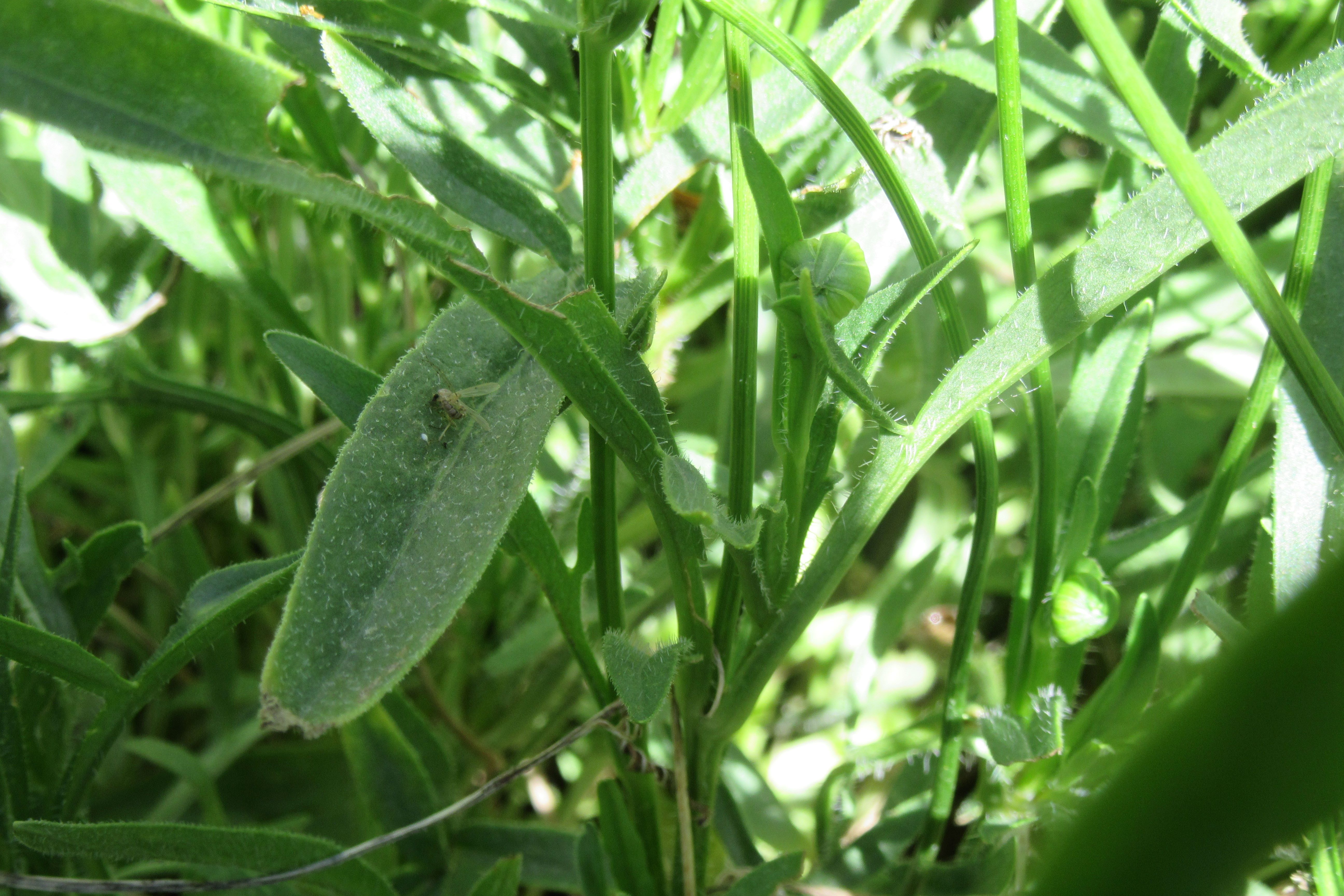

Lance-leaf Coreopsis (Coreopsis lanceolata): foliage

Lance-leaf Coreopsis (Coreopsis lanceolata): leaves


The foliage of Lance-leaf Coreopsis is winter-deciduous in cold climates; the plants die back to the ground once cold weather comes.  New foliage emerges in spring, and plants are fully re-grown by late May in our garden. The foliage is a nice, fresh, medium green.  The leaves (above) are largest at the base (to 4-6 inches), linear to elliptic in shape and occur in opposite pairs.  The leaves can be simple or deeply lobed; hairless or with white hairs (trichomes).  The overall appearance of the foliage is lacy.


Lance-leaf Coreopsis (Coreopsis lanceolata): flowering plant


The flowers of Coreopsis lanceolata grow on slender stalks above the foliage. The flowers grow in a typical Sunflower ‘head’, one to three inches across, with both ray and disc flowers bright yellow (below). There are commonly about eight ray flowers; their toothed tips give a flowering head the ragged appearance typical of Coreopsis.  The ray flowers are sterile; the disc flowers produce the seeds.  The flowering season ie typically from May through summer, depending on local climate.


Lance-leaf Coreopsis (Coreopsis lanceolata): flower head


Individual plants flower from four to six weeks. And this is a real boon for the many pollinating insects that visit this plant.  Long- and short-tongued bees, pollinator flies, wasps, beetles, moths and butterflies all visit Coreopsis lanceolata. The smaller bees are the most common visitors in Mother Nature’s Montrose Garden.  In fact, there are bees visiting these flowers from early morning to evening right now. 

The foliage is host food for several species of moths.  Rabbits and deer may browse the foliage. And seed-eating birds enjoy the seeds in late summer and fall.  All in all, Lance-leaf Coreopsis is a fine habitat plant.  For more see reference 2.


Lance-leaf Coreopsis (Coreopsis lanceolata): bee pollinator


Coreopsis lanceolata is not difficult to grow in USDA Zones 3-10.  It likes sun, but will tolerate part-shade. Any well-drained soil (except salty) is fine – this species isn’t picky.  Ours grow in soil with pH around 8.  Once established, it can tolerate extremes of soil moisture; ours are watered every 7-10 days in summer.  And no fertilizer needed (unless you grow it in a container).


Lance-leaf Coreopsis (Coreopsis lanceolata): plant growth


Plants increase in size if they are happy.  Divide the clump every 2-3 years to maintain vigor. Plants can also be vigorous re-seeders.  If not desired, deadhead the spent flower heads (or collect the dry seeds and give to friends and neighbors). Deadheading may also prolong the bloom period.  Grow a plant or two in containers if spreading will be a problem.  They look great on a patio!

That’s really all there is to plant management. This is quite a hardy plant. Don’t hesitate to trim it back in summer if it gets too unruly.  Lance-leaf Coreopsis appears to be quite resistant to diseases and pests, at least in our experience.


Lance-leaf Coreopsis (Coreopsis lanceolata): with
 native grasses, wildflowers


Why plant Coreopsis lanceolata?   First, its an easy plant to grow in many climates, from arid to humid. You can start plants from seed, making it cost-effective. Seeds can be spread in place in the garden in late fall or early spring.  Alternatively, give the seeds 30 days of cold treatment in the refrigerator.  Barely cover the seeds with sand or potting soil when planting. 


Lance-leaf Coreopsis (Coreopsis lanceolata): with Yarrow


We love the bright yellow flowers for their color in the summer garden.  Pair with blue or purple flowering plants for a real pop of color!  Native grasses, asters and other native annuals and perennials work well with Lance-leaf Coreopsis.  Or plant is near a vegetable or herb garden to attract native pollinators. The flowers produce an attractive yellow natural dye.  You can use the flowers fresh or dried for dye.


Lance-leaf Coreopsis (Coreopsis lanceolata): in garden


We recommend this plant for native gardens, meadows, cottage gardens and other informal settings.  Its size makes it appropriate for lining paths, mid-bed plantings – even massed in country gardens.  The flowers make cheery cut flowers.

Lance-leaf Coreopsis makes a great accent plant and we love it in containers. It can be incorporated into even a small garden.  If you prefer a slightly taller, red-and-yellow annual Coreopsis, we recommend the native Dyers Coropesis Coreopsis tinctoria (see: https://mothernaturesmontrosegarden.blogspot.com/2021/07/plant-of-month-july-plains-dyers.html)

Finally, the North American native Coreopses are a wonderful addition to habitat gardens, providing food for pollinators, other insects and birds.  If you enjoy (or care about) pollinators, butterflies and birds, Coreopsis lanceolata is certainly a plant to consider. 


Lance-leaf Coreopsis (Coreopsis lanceolata): excellent pollinator habitat plant


For a gardening information sheet see: https://www.slideshare.net/cvadheim/gardening-sheet-coreopsis-lanceolata

For more pictures of this plant see:

For plant information sheets on other native plants see: http://nativeplantscsudh.blogspot.com/p/gallery-of-native-plants_17.html

________________

1.        https://www.wildflower.org/plants/result.php?id_plant=cola5

2.        https://www.illinoiswildflowers.info/prairie/plantx/sand_coreopsisx.htm


 _________________________________________________________________


We welcome your comments (below).  You can also send your questions to: monaturesmontrosegarden@gmail.com


Saturday, June 25, 2022

Garden Pollinators: Golden Northern Bumble Bee (Bombus fervidus)


Golden Northern Bumble Bee (Bombus fervidus): nectaring on garden onion

The third week in June is National Pollinator Week (https://www.pollinator.org/pollinator-week).   The word ‘pollinator’ conjures up images of Honey Bees for many people.  But the world of pollinators is far more complex.  Our Garden Pollinators series features some of the many interesting pollinators seen in Western Colorado gardens.  For more on pollinators in general – and tips for attracting pollinators to your garden – see: https://mothernaturesmontrosegarden.blogspot.com/2020/06/life-friendly-gardening-planning-for.html


Golden Northern Bumble Bee (Bombus fervidus): love native Penstemons


One of the busiest pollinators currently in Mother Nature’s Montrose Garden is the Golden Northern Bumble Bee.  This large, bright yellow bee is hard to miss.  You may have seen it in your own garden – or out in the wild.  Its range covers much of North America, with the exclusion of much of the southern United States, Alaska, and the northern parts of Canada. It can be seen in the wild, particularly in grasslands, as well as in cities and farmland.

The Golden Northern Bumble Bee was first identified by the Danish zoologist Johan Christian Fabricius in 1798. [1]  Bombus fervidus is quite similar to Bombus californicus, which has an overlapping range in the western U.S.    Like all Bumble Bees, the species includes males (drones) and two types of females: queens and worker females.


Golden Northern Bumble Bee (Bombus fervidus): characteristics


The Golden Northern Bumble Bee is a large bee, about ½ inch long for drones and workers and slightly more (over 3/4 inch) for the larger queens.  One’s first impression is of a large, very hairy, yellow Bumble Bee.  As seen above, the first four sections of the abdomen are yellow while the terminal segments are black.  The thorax is also mostly yellow, while the face and legs are black (below).  A black band is present between the base of wings.  The underside of the body is also mostly black in females, but may contain more yellow in males.  For more pictures of this species see reference 2.


Golden Northern Bumble Bee (Bombus fervidus): identification


A new Queen mates once with a male drone in fall; then she overwinters by hibernating in the ground. Queens emerge as the weather warms in spring and forage for pollen and nectar (they need energy) and a place to start their nest.  Nests may be either above- or below-ground (more common). Leaving areas of your yard undisturbed is a great way to encourage nesting in your garden.  Nests are made of grass and dung. The nest site is usually within about 150 ft. of flower resources.  

After creating her nest, a Queen collects pollen, which she uses to create food for her initial brood. The honey she makes is stored in special wax compartments – the ‘honey pots’ – in the nest. The nest is composed of individual cells and the Queen lays an egg in each cell.  This initial brood has up to 10 individuals.  When the eggs hatch, the larvae feed on honey until they metamorphose into adults.  Metamorphosis takes about 15 to 25 days.  The emerging adults are the smaller, female worker bees (below).


Golden Northern Bumble Bee (Bombus fervidus): female worker

Golden Northern Bumble Bee (Bombus fervidus):Queen


The first generation of workers provide all the food needed for the next generation of offspring, as well as for the Queen. From this point on, the Queen just focuses on laying eggs. The workers must work very hard; in fact, some work so tirelessly that their lifespan is shortened to a month or less. [3] Some workers expand the nest and keep it tidy. But the workers primarily gather pollen to feed the developing brood. They also chew pollen and mix it with their saliva to make honey. [1] Each generation will be slightly larger than the preceding generation, due to increasing food resources.


Golden Northern Bumble Bee (Bombus fervidus): Queen


The Queen is the only female that can produce female offspring (which only develop from fertilized eggs).  Later in the season, the Queen also lays unfertilized eggs; these develop into males (drones). Also late in the season, she lays eggs destined to become new Queens. These become larger than other females in the nest. Workers can also can lay unfertilized eggs, but these often don’t develop.  For more on the Bumble Bee life cycle see reference 4.


Golden Northern Bumble Bee (Bombus fervidus): great pollinator


Because they are such hard workers, Golden Northern Bumble Bees are excellent pollinators.  Click on the videos below to see how rapidly they work:

Vimeo

Vimeo

Bombus fervidus can be seen foraging whenever the day is warm. They are busy from early morning until evening in our garden.  And they visit a great many flower species. They have long tongues, allowing them to access nectar in tubular-shaped flowers. And they don’t hesitate to climb right into a Penstemon flower. But they nectar at a wide range of types of flowers (below.  They tend to favor plants with many small flowers in our garden: the milkweeds, lilacs, spiraeas, onions, mints, etc.  But they really love the penstemons!  


Golden Northern Bumble Bee (Bombus fervidus): on Apache Plume

Golden Northern Bumble Bee (Bombus fervidus): on Narrowleaf Coneflower

Golden Northern Bumble Bee (Bombus fervidus): on Garden Lilac

Golden Northern Bumble Bee (Bombus fervidus): on Nettle-leaf Agastache


The Golden Northern Bumble Bee is a wonderful pollinator to have in your garden. It is easy to attract, as long as you have plenty of floral resources from early spring through fall.  The Bumble Bees are fascinating to observe – children of all ages enjoy watching them (including us elders). 

Like many Bumble Bees, Golden Northern numbers appear to be decreasing. Part of this decline is almost certainly due to loss of habitat.  Providing food and a place for Bumble Bees to raise their young is a simple way to be a good citizen. It will also guarantee more garden seeds for next year!  

So, plant some native plants and the Bumbles will come. Then upload your photos to Bumble Bee Watch: Bumble Bee Watch.


Golden Northern Bumble Bee (Bombus fervidus): on Palmer's Penstamon


___________

  1. Bombus fervidus - Wikipedia
  2. Bombus fervidus - -- Discover Life
  3. ADW: Bombus fervidus: INFORMATION (animaldiversity.org)
  4. Life Cycle and Biology – Bumble Bees of Wisconsin – UW–Madison


We welcome your comments (below).  You can also send your questions to: monaturesmontrosegarden@gmail.com


Saturday, June 11, 2022

Plant of the Month (June) : Sulphur Buckwheat – Eriogonum umbellatum


Sulphur Buckwheat (Eriogonum umbellatum): Mother Nature's Montrose Garden


There’s nothing like a mass of yellow blossoms to brighten a garden. Our native Sulphur Buckwheat provides a welcome yellow-and-rust accent from May through the summer. That’s why it’s one of the perennial favorites in Mother Nature’s Montrose Garden. The scientific name is pronounced air-ee-OG-oh-num   um-bell-LAY-tum.

The Sulphur Buckwheat is one of about forty Colorado native buckwheats, with three-quarters of them native to the drier Western Slope. Only one-quarter of the Colorado buckwheats are annuals; the majority are either perennials, sub-shrubs or shrubs.  Many make attractive additions to the home garden – if you can find them!

Eriogonum umbellatum is native to Western North America from British Columbia to California on the west coast, and east to Wyoming, Western Colorado and New Mexico. It typically grows in dry, open, often rocky places from sea level to alpine (to 13,000 ft). On the Western Slope, the several variants can be seen in sagebrush flats, on dry slopes, in mountain meadows and in pinyon-juniper, conifer and sub-alpine forests from about 5000 to 13,000 ft [1500-4000 m.] elevation. [1]


Sulphur Buckwheat (Eriogonum umbellatum): California variety


The wide elevation range makes this plant suitable for many gardens in the Western U.S.  Local native plant nurseries often sell local varieties, which often are best suited for regional conditions.   Many native buckwheats, including Eriogonum umbellatum, are also drought tolerant - a welcome bonus, as we transition to more water-wise gardens.


Sulphur Buckwheat (Eriogonum umbellatum): growth habit


Sulphur Buckwheat is quite variable across its range and varieties. It grows as a perennial or sub-shrub, with some variants less than 6 inches tall while others reach up to 3 ft.  Plants have a mounded or mat-like growth habit (above). We grow the ‘Kannah Creek’ type (Eriogonum umbellatum v. aureum ‘Kannah Creek’), a natural cultivar from the near us on the Western Slope.  It reaches 12-15" tall by 15-24" wide, with plants increasing in width with age.  This cultivar is available from several on-line vendors, including High Country Gardens and Annie’s Annuals.


Sulphur Buckwheat (Eriogonum umbellatum): foliage in basal rosette

Sulphur Buckwheat (Eriogonum umbellatum): leaf


The leaves of Sulphur Buckwheat grow in a loose basal rosette.  The leaves are simple, oblong-ovate or oblanceolate to elliptic to oval and may be hairy. The leaf margins are entire and may be wavy in some variants. Leaf color is medium green to gray-green (especially when dry). In colder climates, the leaves turn a rich red-brown with the frosts (below). Plants remain dormant during cold winters.  The species itself is quite cold tolerant and Colorado varieties can be grown in USDA Zones 4-8.


Sulphur Buckwheat (Eriogonum umbellatum): winter color


Growth rate for Eriogonum umbellatum is slow to moderate, with plants expanding to their mature size over several years (below). Plants have a long taproot, which makes them both drought tolerant and difficult to move when mature.  Plants can live to 20 years (perhaps slightly more) in the garden setting.


Sulphur Buckwheat (Eriogonum umbellatum): young plant

Sulphur Buckwheat (Eriogonum umbellatum): maturing plant


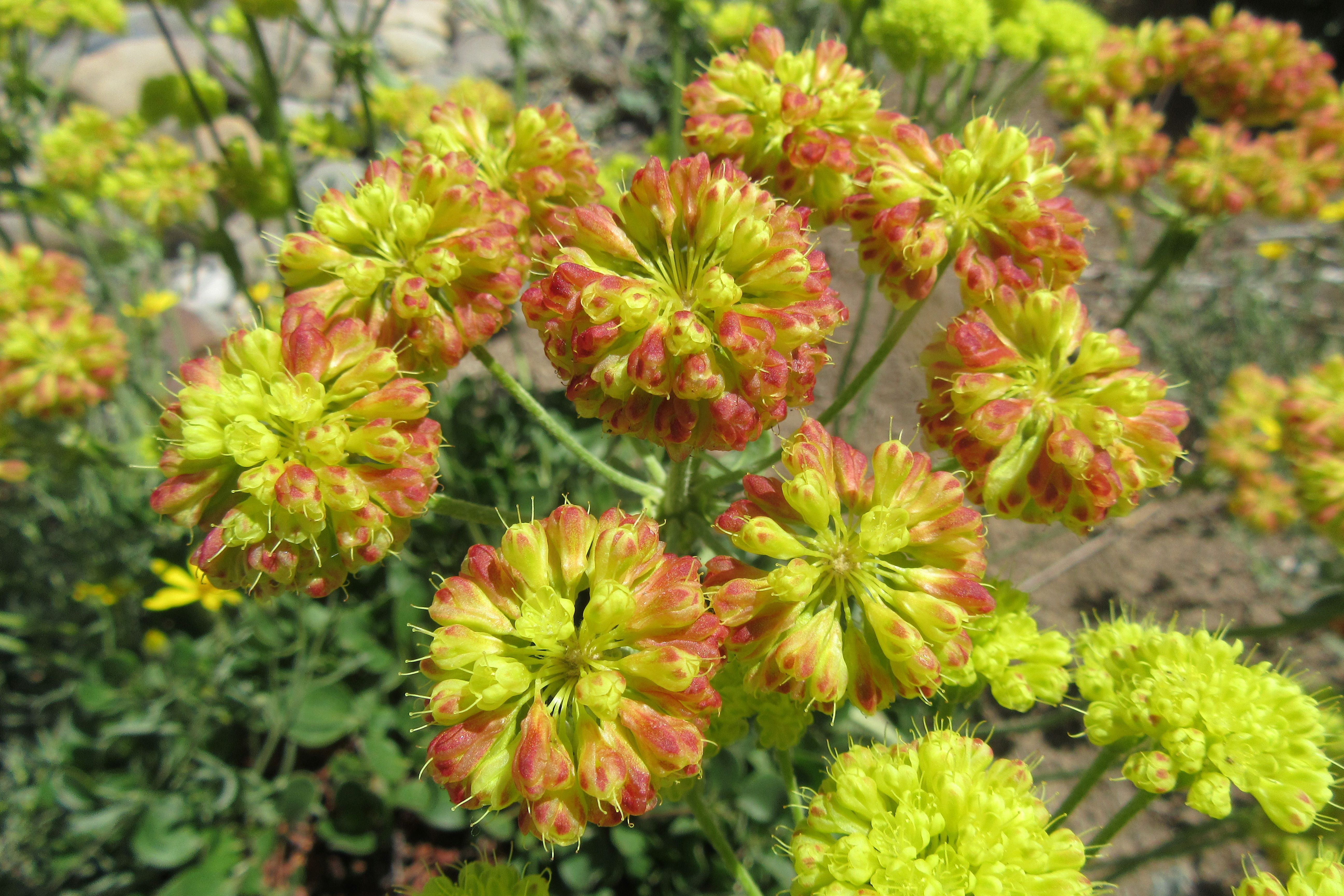
The flowers of Sulphur Buckwheat are spectacular.  The tiny flowers grow in umbels or compound umbels, on flowering stalks above the leaves (below). The flowers are small, sulphur-yellow when fresh, fading to rust orange after pollination (below). The flowers are perfect (both male and female parts in each flower) and the anthers (male, pollen-producing part) extend beyond the petals (this is common in the buckwheats).


Sulphur Buckwheat (Eriogonum umbellatum): flower color

Sulphur Buckwheat (Eriogonum umbellatum): close-up of flowers


The flowers are insect-pollinated, mostly by smaller native bees and flower flies in our garden.  But many other insects may visit this great habitat plant (below). The species is host (caterpillar) plant for the Acmon Blue (Icaricia acmon), Melissa Blue (Plebejus melissa), Blue Copper (Lycaena heteronea), Mormon Metalmark (Apodemia mormo), Square-spotted Blue (Euphilotes battoides), Dotted Blue (Euphilotes enoptes), and Lupine Blue (Icaricia lupini) butterflies. [2]   Birds eat the seeds, so resist the temptation to deadhead the flowering stalks.  They provide an attractive dark brown element to the summer/fall garden as well as providing bird habitat.


Sulphur Buckwheat (Eriogonum umbellatum): small native bee

Sulphur Buckwheat (Eriogonum umbellatum): insect habitat


Sulphur Buckwheat is easy to grow if you choose a variety native to your area and choose a suitable place in your garden. The best strategy is to try to mimic the  growing conditions for your local variety as much as possible. For example, ‘Kannath Creek’ grows in hot, sunny and rocky conditions. We’ve tried to provide those in Mother Nature’s Montrose Garden by planting our plants in the hot, rocky areas around our pond. 


Sulphur Buckwheat (Eriogonum umbellatum): warm, sunny placement


Full sun to part-shade and well-drained soils are a must. Buckwheat plants like a lean soil, so no fertilizer needed (except if grown in a container; even then, a light yearly dose is all). Sulphur Buckwheat tolerates alkali soils (to pH 9.0) and saline soils, both of which are common in some parts of the West.

Don’t over-water this water-efficient plant.  Let the soil dry out between waterings. And don’t plant in an area that gets boggy in the spring.  If your conditions are not suitable, you can even grow Sulphur Buckwheat in a container. Just give it plenty of growing room for its taproot.


Sulphur Buckwheat (Eriogonum umbellatum):
does well in deep containers


Given the right conditions, Eriogonum umbellatum is easy to grow. No pruning or other fussing required - just let the plant do its thing.  And that’s just one reason to include this plant in your garden.


Sulphur Buckwheat (Eriogonum umbellatum):
in Western Colorado garden


Then there’s the distinctive flower hue that adds a pop of color to any spring-summer garden. If you like wildlife, this is a great habitat plant for many insects, including the native spring pollinators.  The neat growth habit makes it a nice accent plant.  We particularly like the low-growing varieties for bordering paths in a water-wise garden. Some gardeners use the shorter varieties as a water-wise ground cover.  It’s a perfect accent in a rock garden.  And an excellent choice for those dry, hard-to-water areas of the garden.


Sulphur Buckwheat (Eriogonum umbellatum): looks nice
 with other native flowers and grasses


So, look around your garden and see if you have the right spot for some Sulphur Buckwheat.  It adds a sense of place to any Western garden. You won’t regret selecting this well-behaved and lovely plant.


Sagebrush Checkerspot on Sulphur Buckwheat (Eriogonum umbellatum):


_______________

  1. Ackerfield, Jennifer: Flora of Colorado.  Brit Press, 2015
  2. Sulphur Buckwheat, Eriogonum umbellatum (calscape.org)


For a gardening information sheet see: Gardening Sheet - Eriogonum umbellatum.pdf (slideshare.net)

For more pictures of this plant see:

For plant information sheets on other Western native plants see: http://nativeplantscsudh.blogspot.com/p/gallery-of-native-plants_17.html


_________________________________________________________________


We welcome your comments (below).  You can also send your questions to: monaturesmontrosegarden@gmail.com


Saturday, May 21, 2022

Plant of the Month (May) : Golden Currant - Ribes aureum

Golden Currant (Ribes aureum):

Every garden needs a bit color in spring.  The locally native currant and gooseberry bushes (genus Ribes) are among the most reliable early bloomers in local gardens.   Our Golden Currant has bloomed now for several weeks and should provide a welcome spot of ‘gold’ for a few more weeks (see above). It’s scientific name, Ribes aureum, is pronounced

ri-BEEZ  OW-ree-um.

The genus Ribes is a member of the Currant family, the Grossulariaceae.  Some taxonomists have placed Ribes in the Saxifrage family, although its members differ significantly from SaxifragaceaeGrossulariaceae is notable for woody deciduous shrubs that produce edible berries; the Saxifrages are herbaceous with dry fruits. The current consensus is that Currants and Saxifrages are sister species; and that the Currant family contains a single genus (Ribes), although some taxonomists place the gooseberries into a separate genus: Grossularia. We’ll have to see how that debate plays out.

The majority of Ribes species are native to the Northern Hemisphere (primarily North America and Asia, but also Europe); species from the Southern Hemisphere are limited to mountainous regions.  Gooseberry species have prickles (thorns) on their stems, while currants do not.  Currants and gooseberries are grown commercially for fruit and also used as ornamental shrubs.


Golden Currant (Ribes aureum): spring buds


There are 10 (possibly 11) different Ribes species native to Colorado.  The western Slope is blessed with several natives, including Ribes aureum var. aureum (Golden Currant), Ribes cereum var. cereum (Wax Currant); Ribes coloradensis [aka Ribes laxiflorum] (Colorado Currant); Ribes interme var interme (Whitestem currant), Ribes lacustre (Prickly Currant), Ribes leptanthum (Trumpet Gooseberry), Ribes montigenum (Alpine Prickly Currant), and Ribes wolfii (Wolf’s Currant).  The Clove/Buffalo Currant (Ribes odoratum; sometimes also known as Ribes aureum var. villosum), native to the U.S. Midwest, is also grown in local gardens, often as the ‘Crandall’ cultivar.


Golden Currant (Ribes aureum): in the wilds, Western Colorado.

Most Western Slope Ribes grow at elevations greater than 4000 ft. (sometimes much higher), usually along stream banks and on mountain slopes.   Our local Golden Currant, Ribes aureum var. aureum, grows from the west coast to the Rockies/Four Corners states, TX and ND, as well as Southern Canada (British Columbia to Quebec). It commonly grows along stream banks and other moist/seasonally moist places in shrubland, woodland and forest communities below 3000 ft (900 meters) elevation.   In Western Colorado, Ribes aureum var. aureum commonly grows from about 4000-8500 ft. elevation.


Golden Currant (Ribes aureum): plant growth and development

Cultivated since the early 1800s , Golden currant is a woody shrub 6-8 ft (~2-2.5 m) tall with a spread of about the same.  Like all currants, its stems are ‘unarmed’.   Unlike some local species, Golden currant grows by adding new stems at the base and sprouting from rhizomes (underground stems).  A young plant will have only a few stems – mature plants will have many more (see above).  The actual stem characteristics depend greatly on the amount of light the plant receives (see below).  The stems are shorter, stockier and more erect in sunnier locations and more wand-like in shade.  


Golden Currant (Ribes aureum): development in sun and shade

Golden currant is stress-deciduous, losing its leaves either during the hot, dry fall  or with the first cold snap.  The leaves are medium green with the three lobes typical of the genus (see photo above).   The leaves become red- or purple tinged – and may become entirely red – in fall.   In fact, they are a good source of fall color in local gardens. 


Golden Currant (Ribes aureum): Fall color


The flowers of Golden currant are a bright, golden yellow – in fact the name ‘aureum’ refers to their golden color.  Plants flower early in the year – as early as  April in USDA Zone 6 and as early as January or february in warmer climates. The bloom season is about a month.  The flowers of Ribes aureum var. gracillimum often become more red as they age, an added benefit this time of year. 


Golden Currant (Ribes aureum): Flowering plant


The flowers have five petals and are ‘perfect’ (have both male and female parts).  While individual flowers are small, the drooping floral clusters are quite showy (see above).   The flowers of var. gracillimum have either no/little scent or a mild sweet fragrance, and many early pollinators that visit them.  We’ve seen native bees (including Bumblebees), European honeybees and pollinator flies visiting our plants in Mother Nature’s Montrose Garden.


Golden Currant (Ribes aureum): flowers, close-up


In warmer climates, rhe most showy visitors (above) are Monarch butterflies and hummingbirds.   Plant any of our native Ribes if you want to attract hummingbirds.  They will fiercely protect their currants and gooseberries from other hummingbirds/insects – and even scold you if they think you’re getting too close!

The fruits of Golden currant are edible – in fact they are among the tastiest of the native currants.   Ripe berries are a translucent orange to red or even dark purple.  You’ll know fruits are ripe when the birds start gobbling them up.  Mockingbirds, Grossbeaks, Robins, Jays, Towhees and others love the fruits.  If you want some for your family’s use you’ll need to be vigilant.   We’ll feature some interesting currant recipes later in the year.


Golden Currant (Ribes aureum): fruiting plant

Golden Currant (Ribes aureum):fruits


Golden currant is tolerant of a range of environmental conditions, making it a good candidate for gardens. It is hardy to USDA Zone 3 and tolerates even the warmth of Southern California. Plants tolerate full sun only in cooler climates.  In most gardens, morning or dappled sun is ideal, although this plant will thrive even in bright shade on the north side of walls or buildings. 

In general, native currants and gooseberries like well-drained soils.  That being said, many of us successfully grow Golden currant in quite heavy clay soils.   The trick is in the watering, and Ribes aureum var. gracillimum is among the most  tolerant of the native Ribes.    It also tolerates a wide range of soil pH, from slightly acid to alkali.

In a dry winter/spring you’ll be wise to water your Ribes deeply, as currants need their winter moisture.  Golden currant even tolerates winter flooding.  Choose a cool, overcast day and water early or late.  In late spring and summer, mature Ribes aureum var. gracillimum can survive on very little water.  We find they look best if given an occasional soaking – perhaps once a month or several times during the summer.  If the leaves are becoming red-tinged or drooping, it’s probably time to water.    Be sure to let the soil dry out between waterings; and overhead watering should be avoided.


Golden Currant (Ribes aureum): water-wise once established


Like most Ribes, native or not, Golden currant is susceptible to fungal infections, particularly under warm, moist conditions.  Plants are an alternate host for white pine blister rust (Cronartium ribicola) which infects white pines (those with needles in bundles of five). You can do several things to prevent fungal infections: 1) locate plants in areas with good air circulation; 2) don’t over-water, particularly during warm weather; 3) don’t plant near white pines.


Golden Currant (Ribes aureum):well-shaped plant


Golden currant is most productive – and looks its best – when pruned as the Native peoples learned to prune it.  Native Americans value native currants as a tasty treat; so in the past, clumps of Ribes aureum were actively managed.   Three-year-old branches are usually past their productive life - pruning out the oldest stems each year will keep your plants neat, healthy and productive.   Start pruning after the second year of growth.  Prune out the oldest 1/3 of the branches (down almost to the ground); then prune out the oldest 1/3 of branches when plants are dormant each fall thereafter.  It is usually easy to tell the oldest stems, even when they are dormant.

Golden current is often used as a shrub in local gardens.  It can be informally espaliered along a wall or fence.  It can even be used for an informal hedge or hedgerow (perhaps with suitable evergreen species).  It doesn’t need much care, so it’s a good choice for hard-to-reach slopes (roots hold the soil) and other ‘challenging’ areas. 


Golden Currant (Ribes aureum): does well along walls and fences


As mentioned above, Golden currant berries are edible, raw or cooked.  They can be used to make pies, tarts, jams, jellies, syrups and cordials.  The flavor is very good.  If planting a native currant for fruit, this is the species to choose.  Native Californians used the inner bark, dried and pulverized or soaked in water, to treat skin infections and sores.


Golden Currant (Ribes aureum): fruits make good eating!

In summary, Golden currant is a great native shrub that provides bright color early in the year, attracts hummingbirds, native pollinators and fruit-eating birds – and provides edible berries.  We hope you’ll consider planting it in your own backyard.


For a gardening information sheet see:http://www.slideshare.net/cvadheim/gardening-sheet-ribes-aureum

For more pictures of this plant see: 

For plant information sheets on other native plants see: http://nativeplantscsudh.blogspot.com/p/gallery-of-native-plants_17.html


We welcome your comments (below).  You can also send your questions to: monaturesmontrosegarden@gmail.com